Overview
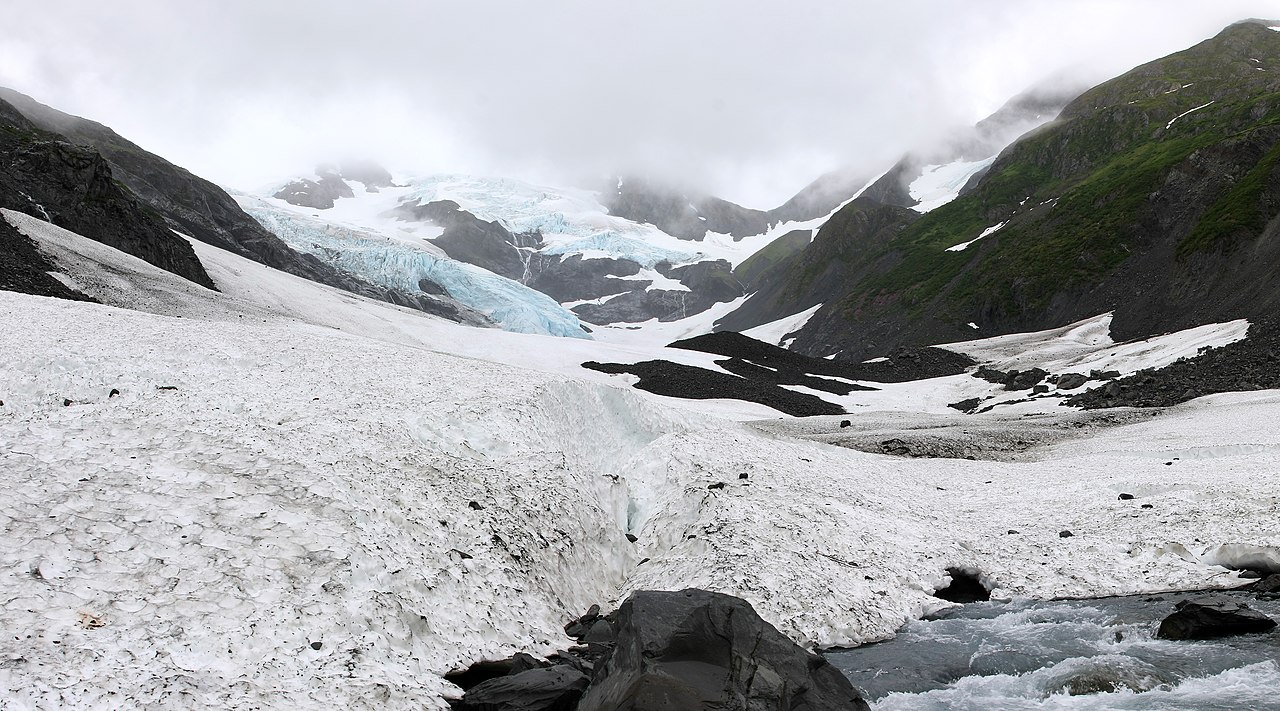
Alaska is by far the largest state of the United States by land area. Nicknamed "the last frontier", Alaska is sparsely populated with a harsh climate but incredible scenery. Separated from the "lower 48" by Canada, Alaska can be a challenging destination; most of the state is in the Arctic. Besides vast forests and frozen tundra, Alaska contains the ten highest mountain peaks in the United States, including Denali, the highest in all of North America.
Updated from Wikivoyage on 1 October 2026 · Something wrong or missing? Improve it on Wikivoyage
Plan your trip
Best time to visit & weather
Most comfortable: Jun–Jul. Summer highs reach about 66°F; winter lows dip to about -6°F. Cold months (Jan, Feb, Mar, Oct, Nov, Dec) can bring snow and ice; check road conditions. Wettest: Jul and Aug. (climate data from nearby Denali National Park)
Blue bars: average daily high and low (°F). Purple columns: average monthly rain and melted snow (inches).
Getting there
- From you: to see whether to drive or fly, and how long it takes.
- RBY Ruby Airport, Ruby — 115 mi away. Directions
- MCG McGrath Airport, McGrath — 133 mi away. Directions
- ANC Ted Stevens Anchorage International Airport, Anchorage — 205 mi away (major hub). Directions
Anchorage, and to a lesser extent Fairbanks, are served by Alaska Airlines and Delta Air Lines year round from the lower 48, particularly from Seattle but also from other cities in the lower 48 (such as from Denver on United). Juneau, Ketchikan, Petersburg, Sitka, and Wrangell are also served by daily jet service through Alaska Airlines flights originating in Seattle and terminating in Anchorage, on a point to point routing system. Other airlines, such as Air Canada, Allegiant Air, American Airlines, Sun Country, and other international carriers, offer service to Anchorage on a seasonal basis rather than all-year round. Other communities within the state are served by an extensive system of regional and local air services from Anchorage, Fairbanks, Juneau, and Ketchikan, the state's four largest urban areas (See "By Air" under "Getting Around" in below). Because of vast distances and the limited number of roads, air travel is the cheapest and most efficient form of transportation in and out of the state. Ted Stevens Anchorage International Airport accommodates the upsurge in tourism and serves over 5 million passengers annually (2018). Anchorage International is a very big and clean airport that isn't very crowded. It has many different amenities for awaiting passengers to enjoy. They have everything from shops, restaurants, duty-free shops, and bars by where you board your plane. Be sure to check out the various animal displays for an early look at some of the state's more difficult to find inhabitants. A record-size halibut can be found on display just below the stairs that lead from the main concourses to baggage claim. Below that, you'll find several other animal specimens worth a glance on your way to your rental car or other transportation. The biggest problem with flying into Anchorage is that if you're not staying in Anchorage, you are going to need to take a long drive to wherever your destination is; most people just rent a car, which can be costly. If you are visiting family, you are better off just having them come and pick you up by the Security Screening area or meet you at the Baggage Claim area. No one likes to embark on a long drive after a long flight, but the scenery you will see will make you forget all about the long-distance journey.
Full “Get in” guide ↓Sample 3-day trip
- Day 1: Southeastern Alaska — explore the town.
- Day 2: Arctic Alaska — explore the town.
- Day 3: Southwestern Alaska — Mulchatna River.
Built from the best-covered destinations in this region; open each for its own day plan.
Food for you
Alaskans love their food, fresh or otherwise you need good feed to keep up with daily life here. The portions in this state are huge. Almost every little town will have a local diner where one can get a filling breakfast and lots of hot coffee. Try the reindeer sausage with your eggs and hash in the morning and you'll feel like a true Alaskan.
Some foods indigenous to this area are fireweed honey (distinctive and quite uniquely delicious), and spruce tip syrup made from the Sitka spruce which grows very commonly throughout Alaska; and of course there is perhaps the most well known of all Alaskan produce: seafood. Alaska's fishing grounds are among some of the richest in the world and feature among other delicacies King and Snow crab which are exported the world over. Many local restaurants close to the shore serve fresh halibut and salmon daily, right off the boats. Fried halibut less than 24 hours out of the water is an experience like no other. The fish doesn't even need to be chewed it is so tender. Fresh salmon is usually best grilled or roasted . Crab is almost always pre-boiled at sea to preserve its freshness. Most coastal towns also have at least one place serving sushi made with local fish. Restaurant prices, like most other things in Alaska do tend to be rather high but the experience of eating truly fresh seafood is worth it. Most things in Alaska are going to feel like they are overpriced, but they are expensive because it is so expensive to transport goods and food to Alaska. If you are out to eat, don't rob yourself by ordering pasta or spaghetti, get some type of seafood or meat. Do not expect to find moose, bear, or other truly wild game on the menu at restaurants, as it is illegal to sell game meat. Reindeer can commonly be found, and elk or yak will show up on occasion; in these cases, the animals have been raised domestically. A lot of restaurants in Alaska serve "catch of the day" and other seafoods, especially along the coast. Chefs will almost always have a new spin on your favorite seafood that you'll never have the opportunity of trying again. Alaska is famous for their Alaskan King Crab legs. Many people think that they've had them before, but oftentimes they are sold as Alaskan king crab legs in the lower 48 states and they aren't actually Alaskan king crabs, and if they are, they aren't even close to as fresh as they are in Alaska. Many restaurants will cook them in lemon juice, butter, and Old Bay seasoning. You will know when you've had an Alaskan king crab leg because the legs are about the same thickness as a woman's wrist.
What to ask about, for your diet
Diet labels come from each listing's description and cuisine; “likely” means the cuisine usually has good choices, not a promise. Check with the restaurant. Open the food finder
Photos


Places in Alaska
Understand
In 1867 (two years after the end of the Civil War), the territory of Alaska was purchased from the Russian Empire for $7.2 million (or about 2 cents an acre). For many years people referred to the acquisition as "Seward's Folly", named for Secretary of State William H. Seward (1801–1872) who made the deal. They viewed Alaska as a frozen wasteland, not realizing it would turn out to be one of the United States' richest resources for gold and oil.
It took until 1959 for the territory to become a state of the Union. Most of the land is still wilderness; nicknamed The Last Frontier, Alaska keeps the spirit of the Wild West alive.
Most maps of the US represent the size of Alaska inaccurately, inserting it at a smaller scale in some corner. On the other hand, Mercator maps make northern regions such as Alaska look larger – it isn't the size of Brazil, just a fifth of it, which still is huge, more than twice the size of the second biggest US state, Texas.
Most of northern Alaska is incredibly sparsely populated. Many places are only reachable by air or water and roads take a toll from the harsh climate, so carefully plan your itinerary before heading out. That being said, a truly breathtaking environment will more than make up for the hardships of getting there and around. With the size, climate also varies with moderate rainy climates in the south and ice desert in places like Utqiaġvik (Barrow); see also Winter in North America.
The fact that it was only colonized relatively lately (Russian presence never amounted to more than a few thousand fur trappers along the coast) makes for a relatively strong presence of native populations who – along with state and federal government entities – still own large parts of the land (see the map above).
Alaska observes all the federal holidays, except Columbus Day, and adds Seward’s Day (last Monday in March) and Alaska Day (October 18th). However, some cities and towns that have a large population of federal workers or military personnel may observe Columbus Day, anyway.
Alaska's oil wealth has allowed it to be the only state to provide its citizens with a universal basic income of around $1,600 a year.
Tourist information
- Travel Alaska website
Regions
Unlike other American states, which are administratively divided into counties, Alaska's sub-divisions are known as boroughs.
Southeastern Alaska
The Panhandle and the Inland Passage
Southcentral Alaska
Anchorage and the Kenai Peninsula
Southwestern Alaska
Alaskan Peninsula and various islands, including the Aleutian Islands
Interior Alaska
Fairbanks, Yukon River
Cities
- Juneau – State capital and third largest city.
- Anchorage – Alaska's largest city.
- Utqiaġvik (Barrow) – northernmost city in the United States and mainland North America
- Deadhorse – Alaska's oil center, the production facilities can only be accessed by tours
- Dutch Harbor (Unalaska) – Largest community in the Aleutian Islands; internationally famous as the home port for the reality TV series Deadliest Catch
- Fairbanks – Alaska's second largest city
- Homer – Halibut Fishing Capital of the World, Kachemak Bay State Park, Katmai National Park
- Ketchikan – Alaska's southernmost city and the first Alaska port for northbound cruise-ship travelers.
- Kodiak – The Island Town
Other destinations
- Denali National Park – whether climbing or admiring, the crowning jewel of North America's highest peak is the awe inspiring 20,320-foot Denali (formerly Mt McKinley)
- Gates of the Arctic National Park – traveling through this vast wilderness you will discover craggy ridges, glacier carved valleys and fragile flowers
- Glacier Bay National Park – marine wilderness of Glacier Bay National Park and Preserve includes tidewater glaciers, snow-capped mountain ranges, ocean coastlines, deep fjords, and freshwater rivers and lakes.
- Katmai National Park – famous for volcanoes, brown bears, pristine waterways with abundant fish, remote wilderness, and a rugged coastline
- Kenai National Wildlife Refuge a massive wilderness of mountains and lakes, swarming with wildlife
- Kenai Fjords National Park – a land where the ice age still lingers where glaciers, earthquakes, and ocean storms are the architects.
- Lake Clark National Park and Preserve – The Park was created to protect scenic beauty (volcanoes, glaciers, wild rivers and waterfalls), populations of fish and wildlife, watersheds essential for red salmon, and the traditional lifestyle of local residents. Lake Clark's spectacular scenery provides a true wilderness experience for those who visit.
- Wrangell-St. Elias National Park and Preserve – Chugach, Wrangell, and Saint Elias mountain ranges converge here in what is often referred to as the "mountain kingdom of North America." It has the continent's largest assemblage of glaciers and greatest collection of peaks above 16,000 ft.
- Yukon - Charley Rivers National Preserve – along the Canadian border in central Alaska
Get in
By plane
Anchorage, and to a lesser extent Fairbanks, are served by Alaska Airlines and Delta Air Lines year round from the lower 48, particularly from Seattle but also from other cities in the lower 48 (such as from Denver on United). Juneau, Ketchikan, Petersburg, Sitka, and Wrangell are also served by daily jet service through Alaska Airlines flights originating in Seattle and terminating in Anchorage, on a point to point routing system. Other airlines, such as Air Canada, Allegiant Air, American Airlines, Sun Country, and other international carriers, offer service to Anchorage on a seasonal basis rather than all-year round. Other communities within the state are served by an extensive system of regional and local air services from Anchorage, Fairbanks, Juneau, and Ketchikan, the state's four largest urban areas (See "By Air" under "Getting Around" in below). Because of vast distances and the limited number of roads, air travel is the cheapest and most efficient form of transportation in and out of the state. Ted Stevens Anchorage International Airport accommodates the upsurge in tourism and serves over 5 million passengers annually (2018). Anchorage International is a very big and clean airport that isn't very crowded. It has many different amenities for awaiting passengers to enjoy. They have everything from shops, restaurants, duty-free shops, and bars by where you board your plane. Be sure to check out the various animal displays for an early look at some of the state's more difficult to find inhabitants. A record-size halibut can be found on display just below the stairs that lead from the main concourses to baggage claim. Below that, you'll find several other animal specimens worth a glance on your way to your rental car or other transportation. The biggest problem with flying into Anchorage is that if you're not staying in Anchorage, you are going to need to take a long drive to wherever your destination is; most people just rent a car, which can be costly. If you are visiting family, you are better off just having them come and pick you up by the Security Screening area or meet you at the Baggage Claim area. No one likes to embark on a long drive after a long flight, but the scenery you will see will make you forget all about the long-distance journey.
Fairbanks International Airport, a state-owned public-use airport 3 mi southwest of downtown, offers basic services for travelers.
By car
Alaska is connected to the contiguous U.S. (known in Alaska as the "Lower 48" or "outside") through Canada via the Alaska Highway. The highway is paved and maintained year-round. Sometimes it can seem a little over-maintained, creating a uniquely Alaskan and Canadian situation: at any given time in the summer, you're bound to hit at least several dozen (and sometimes hundreds of!) miles of road construction. Since the roads in construction zones usually have only one working lane and, due to the scarcity of roads in the rural areas, there are not always alternate routes available, the construction companies operate "pilot cars" (usually pick-up trucks with yellow rotating beacons and large signs that say "Follow me"). They drive back and forth between the two ends of the construction zone and lead the vehicles safely to the other end. Depending on the length of the construction zone, the wait can be anywhere from 10 minutes to several hours. Since there's only one main road, you can't really drive around the construction. The roads that aren't being worked on are usually in great condition. Considering the winter conditions, the roads are in great condition. Every year Alaska gets hit with tons of snow, and the roads take a pounding because of all the weight and plowing that must occur. It is easy to complain about all the construction, but without it people would complain more about the road conditions. Most of Alaska's highways are smooth and freshly paved. All-terrain vehicles (ATVs) are very common for natives to use when traveling short distances. Be careful of them while you're driving because they come out from all areas: both on-road and off-road.
If you're planning to drive to or around Alaska, make sure to pick up a copy of The Milepost, which is widely regarded as the premier road guide for western Canada and Alaska. Most roads in these regions have small white posts every mile or so indicating the number of miles from the start of the road. The Milepost has extremely detailed route descriptions of all of the roads, pointing out everything from scenic viewpoints and campgrounds down to the names of small creeks the roads pass over. If you're flying in to Anchorage and then driving around the state, pick up a copy of The Milepost at one of the local Costcos or Walmarts – the price there is around half of list price.
Driving distances in Alaska may be far greater than you are used to. Although the speed limit on most of the paved highways in state is set at 65 mph (there are lower limits near towns and in highway safety corridors, most notably on the Parks and Seward Highways), these are not freeways, and safe passing zones are limited on many stretches of road. You are likely to encounter large numbers of semi trucks, particularly on the Parks, Elliott, and Dalton Highways, as well as private vehicles hauling large tow-behind trailers. Take extra care when attempting to pass these vehicles, as they may be longer than they appear to be from behind.
There may be restrictions on which highways rental vehicles may be taken on. The Dalton, Denali, Steese and Cassiar Highways, and the Nabesna and McCarthy Roads, in particular, are considered no-gos by many vehicle rental companies; if your rental vehicle is damaged on one of these routes, insurance purchased through the rental company may not cover repair or retrieval expenses. Always check for restrictions before making plans to travel any of the state's unpaved highways.
If you will be traveling on one of the state's unpaved roads, go prepared. Distances between services are frequently large, weather can change rapidly and without warning, and many reaches of the state outside of the population centers lack cell service. Travelers on the Dalton, upper reaches of the Elliott, Steese, and Denali Highways are especially well advised to carry extra fuel, at least one spare tire, and basic survival gear.
Some rental car companies may offer one-way rentals in and out of the state in the shoulders of the tourist season (one-way into the state before summer and one-way out of the state after summer). Check with each agency for details.
If an immigration issue prevents you from entering Canada, you cannot enter Alaska by car from the contiguous states. Canadian customs regulations state that Canadian residents may not rent a vehicle in the United States (including Alaska) and drive it into Canada.
By boat
The Alaska Marine Highway System operates a ferry service from Bellingham, Washington up the beautiful Inside Passage to Haines. Plan your travel early as this service tends to fill up fast. A connecting ferry can take you to Whittier (although this service is much less frequent—suggest you call for details) from which the Alaska Railroad connects to Anchorage. The Marine Highway also operates along the coast of South central Alaska, the Aleutian Islands, and Prince William Sound. Some private companies operate shuttle vans between Whittier and Anchorage as well, and the combination rail/highway tunnel allows road traffic in alternating directions every half hour. There is only one rental company in Whittier, Avis, which operates seasonally and with a limited number of cars. If you're arriving by ship without a car and want to drive to Anchorage, make reservations well in advance for one-way rentals and be prepared to pay an extremely high rate and a substantial one-way drop fee. Unless you've got five people and tons of luggage, it's usually better to make alternate arrangements (train or bus) to Anchorage and rent a vehicle there.
As mentioned above, Avis also offers one-way rentals from Skagway to the rest of Alaska. The only road from Skagway to the rest of Alaska travels through Canada.
Various cruise lines sail up the Inside Passage as well, typically ending in Seward or Whittier (these cruise lines usually—but not always, so check—provide transportation to Anchorage and may even include package tours or your return air travel out of the state). Cruises depart from cities such as Seattle, Vancouver, and even San Francisco.
Boats are a necessity in a lot of areas of Alaska. There are still many natives who rely on the use of their boats to get them into town for things such as shopping. If you are going on a fishing or hunting trip, chances are you are going to have to take a boat to get to your destination. You can drive into town from the airport and park your car at a loading dock for either short-term or long-term parking. From there, you can either board your own private boat or take a commercial boat to where you need to go. Many of the hunting and fishing expeditions will have a boat ready for you at a certain time to get you where you need to be for your adventure. Alaskan natives will bring their boats to these docks and park them there while they do their shopping. When they're done, they will load up and take the trip back to their respective house or cabin. This process can sometimes be very difficult and strenuous, especially for older adults and younger children.
The Yukon River once played a huge role in accessing the interior of Alaska. Commercial steamboats once operated in the region, and goods are still transported by ship into remote interior areas. Some other rivers are also navigable. Though there is nothing that smacks of passenger service, it is theoretically possible though difficult to arrange a ride on a cargo ship, but you will have to do your own research.
By bus
Given the distances involved and the fare required to travel those distances, the cost of taking a bus from Canada and the lower 48 to Alaska vs. flying is about the same – and there is no scheduled service to Alaska by bus. There may be bus tours though.
Get around
Most cities and villages in the state outside of the south-central region or southern interior are accessible only by sea or air. The Alaska Marine Highway System also serves the cities of Southeast and the Alaska Peninsula. Cities not served by road or sea can only be reached by air, accounting for Alaska's extremely well-developed bush air services—an Alaskan novelty.
By plane
Although Anchorage is accessible via most major domestic carriers and some international carriers, Alaska Airlines has a virtual monopoly on jet air travel within the state, meaning prices are extremely high in comparison to comparable distances in the lower 48. The airline offers frequent jet service from Anchorage and Fairbanks to regional hubs like Bethel, Nome, Kotzebue, Dillingham, Kodiak, and other larger communities as well as to major Southeast and Alaska Peninsula communities. Smaller communities are served by the main regional jet and turboprop commuter airlines: Grant Aviation and Ravn Alaska. The smallest towns and villages must rely on scheduled or chartered Bush flying services using general aviation aircraft such as the Cessna Caravan, the Piper Navajo, or the smaller Cessna 207, the most popular aircraft in use in the state. But perhaps the most quintessentially Alaskan plane is the seaplane. The world's busiest seaplane base is Lake Hood, next to Ted Stevens airport in Anchorage, where flights bound for remote areas carry passengers, cargo, and lots of items from Costco and Sam's Club.
Small planes are a great way to get around Alaska if you are able to afford it. After you have touched down from your main flight to Alaska, you can board small planes that can transport you fast and efficiently. Many places aren't accessible by car or truck; so small planes are commonly used to get to the destinations quickly. If you are going on a hunting trip, chances are that you will need to board one of these planes to get there. Hunting areas in Alaska are sometimes commercialized for tourists. The areas that they bring you to are commonly hunted by other tourists. This continued use has made it a lot easier for pilots to land. A pilot can land on flat ground that is continuously used for landing small planes onto.
ConocoPhillips and BP also have their own airline as ConocoPhillips/BP Joint Joint Service Aviation which operates shuttle flights (on leased Boeing 737 planes) to the North Slope from Anchorage and Fairbanks for employees and contractors of BP, ConocoPhillips and other contracting companies established in the North Slope.
By train
- The Alaska Railroad runs from Seward through Anchorage, Denali, and Fairbanks to North Pole, with a spur to Whittier. The railroad is famous for its summertime passenger services but also plays a vital part in moving Alaska's natural resources—primarily coal—to ports in Anchorage, Whittier and Seward as well as fuel and gravel for use in Anchorage. The Alaska Railroad is the only remaining railroad in North America to use cabooses on its freight trains. The route between Talkeetna and Hurricane (between Talkeetna and Denali) features one of the last remaining flag stop train services in North America. A stretch of the track along an area inaccessible by road serves as the only transportation to cabins in the area. Residents board the train in Talkeetna and tell the conductor where they want to get off. When they want to come to town, they wait by the side of the tracks and "flag" the train, giving it its name.
Go White Pass and Yukon Route
Operates out of Skagway, Alaska, and stops in Northern British Columbia on its way to Carcross, Yukon. Provides access to a trailhead of the Chilkoot Trail. Service operates from May to early October.
By car
Alaska is the least-connected state in terms of road transportation. The state's road system covers a relatively small area of the state, linking the central population centers and the Alaska Highway, the principal route out of the state through Canada. The state capital, Juneau, is not accessible by road, which has spurred several debates over the decades about moving the capital to a city on the road system. One unique feature of the road system is the Anton Anderson Memorial Tunnel, which links the Seward Highway south of Anchorage with the relatively isolated community of Whittier. The tunnel is the longest road tunnel in North America at nearly 2.5 miles and combines a one-lane roadway and train tracks in the same housing. Consequently, eastbound traffic, westbound traffic, and the Alaska Railroad must share the tunnel, resulting in waits up to 45 minutes (or more) to enter; for specific times, see the schedule.
In their daily discourse Alaskans never refer to roads or highways by numerical designations, instead preferring named designations such as “Seward Highway” or "Glenn Highway”. If you use the route numbers, Alaskans will probably not know what you are referring to.
Anchorage and Fairbanks are served by all of the major national rental car chains as well as a number of independents. Some smaller towns around the state may also have a national chain company presence. Renting a car in Alaska can be more expensive than pretty much anywhere else in the United States, ranging up to (and occasionally even over) $200 per day for a large vehicle sufficient to carry multiple passengers and outdoor gear during the peak season. In the dead of winter, however, you can sometimes grab a vehicle for under $10 per day.
Renting at the Anchorage or Fairbanks airport incurs a 10-12% additional airport surcharge (plus an additional $4.81 per day in Anchorage). If you're renting for more than a few days, it might be worth the hassle to rent your vehicle at an off-airport location, which usually involves taxi rides or shuffling between hotel and rental car courtesy shuttles. Check with each agency or search off-airport rental cars using an online travel agency to see what cost savings may be available.
Be aware that in winter, roads are maintained for winter drive-ability. Outside of urban centers, they are generally not cleared "down to the pavement" and salt application is unheard of in much of the state, with sand being used instead to add traction. There is therefore still a layer of snow or ice on top of the road surface, which is actually optimal for a properly outfitted vehicle with appropriate tires, which your rental car probably is not.
By bus
For those traveling independently without a car there are several companies that connect Anchorage to the Kenai Peninsula to the south and to Denali National Park and/or Fairbanks to the north in the Interior and South Central parts of the state on a regularly scheduled basis, where it's most accessible by road. There are also limited services up to Prudhoe Bay on the Arctic coast from Fairbanks by the Dalton Highway Express and over to Whitehorse YT by Alaska Yukon Trails. Bus services outside of the Interior and South Central regions are limited due to a limited availability of roads. See the respective article for a particular locale as to what may be available there. Bus companies in Alaska come and go frequently with one going out of business and another taking its place while some merged into one company. The following have been consistent and stable over the last few years:
Place Interior Alaska Bus Line
Year round service on Mondays, Wednesdays, and Friday between Tok and Anchorage, and Tok and Fairbanks. Trips between Tok and Anchorage stop along the way at locations including Glennallen and Palmer. Trips between Tok and Fairbanks stop along the way at locations including Delta Junction. Trips depart from Tok in the morning and return to Tok in afternoon. Therefore to travel involving switching between the routes at Tok requires multiple nights stay in Tok. Be sure to reserve in advance and allow some flexibility in your schedule as buses may be rescheduled based on demand.
Place Park Connection Motorcoach
The Park Connection bus line offers service in Alaska from Seward and Whittier in south, all the way north through Anchorage and Talkeetna to Denali National Park. They have multiple trips per day to most destinations, including the Park to Park, Denali Express, Seward Express, Whittier Cruise Shuttles and Seward Cruise Shuttles.
Place Stage Lines
They offer passenger transportation, freight, parcel, and courier service, between Anchorage and several places in the Kenai Peninsula to the south.
Some of the above companies also offer chartered and sightseeing services in addition to their regularly scheduled services. Some may operate seasonally in the summer while others operate year round with different schedules for winter and summer. Check their website or call them.
Information on transit can be found here.
By bike
While sidewalks and bike paths are present in the main cities, bicycling along the major highways is a dangerous proposition. Areas near the main cities occasionally offer bike paths and wide shoulders, but many areas of Alaska's main highways are not advisable for bicycling. The Seward and portions of the Glenn Highways, in particular, have very narrow shoulders and are flanked by cliffs on one or both sides, leaving very little or no room for pedestrians and bicyclists to travel safely.
By boat
One of the best ways to see Alaska is by cruise ship. Cruise ships bring you wonderfully close to glaciers, whales and rocky coasts. Larger boats offer more amenities, while small ships and yachts carrying 12-100 passengers go where the big ships can't, getting you up close to Alaska's nature and wildlife. Many vessels include naturalist guided hikes and sea kayaking right from the ship, perfect for active, casual travelers.
Cruise ships have 2 main itineraries: the Inside Passage Route going roundtrip from either Seattle, Washington or Vancouver, Canada and the Gulf Route running Northbound and Southbound cruises between Vancouver and Seward/Whittier.
Companies offering cruises in Alaska include:
- Holland America. The Glacier Discovery Cruise offered by Holland America Line, runs between Seward and Vancouver, BC.
- Princess Cruises, offers both Inside Passage and Glacier Bay routes as well as roundtrips from San Francisco.
- AdventureSmith Explorations Expedition and small ship cruises statewide aboard ships and yachts carrying 12-132 guests.
- Adventure Life, offers small-ship cruising exclusively, working with vessels in Alaska ranging from 32 to 138 passengers.
- Norwegian Cruise Line, offers only roundtrips in Seattle and Vancouver.
- Carnival Cruises, has only one ship deployed in Alaska annually doing mainly Northbound and Southbound cruises.
- Regent Seven Seas Cruises, luxury cruise line with all inclusive cruises to Alaska.
- Cruise 118, Cruise 118 Holiday Cruises from Southampton to the Mediterranean, Alaska and the Caribbean.
- Disney Cruise Lines Inside passage trip to Tracy Arm, Ketchikan, Skagway, and Juneau leaving from Vancouver~This is a great way to see the glaciers in Tracy Arm, as it is smaller than Princess or Carnival, so it can get closer, farther, and do a 360° turn
Ferry
- Alaska Marine Highway System, +1-800-526-6731. Alaska's Marine Highway consists of over 8000 miles of coastal ocean routes connecting 31 port communities throughout Southeast, Southcentral and Southwest Alaska. Two additional ports are located outside of Alaska - one in British Columbia and the other in the state of Washington. It forms an essential method of transportation for many local residents in towns to which there is no road access. The Marine Highway system also allows walk-on travelers, bicycles and commercial vehicles. You can arrange your own cabin on the ferry, pitch a tent, or roll out a sleeping bag on the upper decks. Naturalists sometimes on board to give commentary on sights and wildlife.
Of course, after you get off the boat, you'll want to stay and explore Alaska's inland destinations. Don't get straight on an airplane and head home—you'll miss out on some of the best Alaska has to offer!
Also try a fishing charter at any of Alaska's fine coastal communities and send your catch home to your family or friends.
See
Alaska is huge. It spans what once were five time zones! It's so big in fact you probably won't scratch the surface of what it has to offer in terms of geography, wildlife, local flavor, or Alaska native culture.
You might visit a couple of the regions of the state during your visit. It is quite possible to experience the ancient rainforest of Southeast Alaska, camp in Denali National Park, and kayak among icebergs in Prince William Sound on the same trip.
Another option is to focus on a smaller (still huge) region of the state and spend enough time for a better look and then plan a return trip to explore a different region. Alaska does not have to be a once in a lifetime destination.
Three weeks in the Inside Passage, traveling from town to town by ferry, is likely to leave you wanting more time if you enjoy hiking, sea kayaking, fishing, wildlife watching, scenery, Native culture, and biking.
The Kenai Peninsula, south of Anchorage, is another region worthy of an extended stay and is easily accessed from Anchorage. Plenty of public campgrounds make this an extremely affordable do-it-yourself destination if you have a few folks to share the cost of a rental car.
An Anchorage, Denali, Fairbanks, Valdez driving loop also offers plenty to see and do for two weeks or more and can be quite affordable with camping and a shared rental car.
Do
There are many things to do when traveling to Alaska. If you are the adventurous type then Alaska will be a great place to go. You can go hiking, biking, kayaking, fishing, and expeditions to see the wildlife of Alaska like wolves, whales, moose, and bears. There are also month-long expeditions to the top of Denali.
- A journey on the Dalton Highway provides a unique experience. The highway crosses mountains and tundra, the Arctic Circle, and 414 miles of pristine wilderness.
- Stay up late to see the midnight sun, it's fascinating to watch in the summer when daytime seems endless.
Anyone traveling to Alaska should definitely make a trip to Denali; it is absolutely beautiful and the highest point in North America. You can see it from hundreds of miles away when there are clear skies. However, if you get the opportunity to take a trip to see it up close, do it. An ATV ride up the side of a mountain can be one of the most eventful experiences of your trip. On the way up the path, you will see vegetation and wildlife that you can't see anywhere else. Once you finally get to the top of the mountain, you will see one of the most beautiful sites in all of the United States. Digital cameras and photos don't do the mountain's beauty enough justice. The mosaic of blues, whites, grays, and greens will leave you absolutely astonished.
Not everyone is a fisherman; many people enjoy catching fish but hate waiting around to try to catch one. Well if you are one of those people, try fishing in Alaska. You will be amazed at how quickly you can catch fish there if you are in the right spot. You can definitely leave the river every day with your daily limit of fresh Alaskan salmon. There are plenty of charter fishing operators that will take you out to fish in some of the best areas.
Buy
In Alaska cruise ports (especially Ketchikan, Juneau and Skagway) the tourist shopping experience is dominated by jewelry, tee shirts, and trinkets that could be purchased at any major cruise port in the world (perhaps from the same chain shop). Yes, there are good buys occasionally (especially at the end of the season), but local products can be difficult to find.
If you are on a cruiseship, don't be afraid to visit stores not listed on the "preferred business'" list provided by the cruiseline. Those businesses paid a premium to be listed and don't necessarily represent higher quality or better selection.
Local Alaskan artists are found in co-op and locally owned galleries. There are many books, from fiction to photos to nonfiction to children's, by Alaska writers, photographers and illustrators.
Be sure to look for the distinctive 'Made in Alaska' sticker on products in gift shops and stores. When purchasing Native-made handicrafts, keep the laws of your home country in mind; foreign travelers may find that they cannot bring their purchase home due to regulations regarding one or more of the materials used, which frequently range from whale baleen and bone to various furs, skins, teeth and other wild animal products, and may in some cases include artifact materials such as fossilized bone or tusk.
Eat
Alaskans love their food, fresh or otherwise you need good feed to keep up with daily life here. The portions in this state are huge. Almost every little town will have a local diner where one can get a filling breakfast and lots of hot coffee. Try the reindeer sausage with your eggs and hash in the morning and you'll feel like a true Alaskan.
Some foods indigenous to this area are fireweed honey (distinctive and quite uniquely delicious), and spruce tip syrup made from the Sitka spruce which grows very commonly throughout Alaska; and of course there is perhaps the most well known of all Alaskan produce: seafood. Alaska's fishing grounds are among some of the richest in the world and feature among other delicacies King and Snow crab which are exported the world over. Many local restaurants close to the shore serve fresh halibut and salmon daily, right off the boats. Fried halibut less than 24 hours out of the water is an experience like no other. The fish doesn't even need to be chewed it is so tender. Fresh salmon is usually best grilled or roasted . Crab is almost always pre-boiled at sea to preserve its freshness. Most coastal towns also have at least one place serving sushi made with local fish. Restaurant prices, like most other things in Alaska do tend to be rather high but the experience of eating truly fresh seafood is worth it. Most things in Alaska are going to feel like they are overpriced, but they are expensive because it is so expensive to transport goods and food to Alaska. If you are out to eat, don't rob yourself by ordering pasta or spaghetti, get some type of seafood or meat. Do not expect to find moose, bear, or other truly wild game on the menu at restaurants, as it is illegal to sell game meat. Reindeer can commonly be found, and elk or yak will show up on occasion; in these cases, the animals have been raised domestically. A lot of restaurants in Alaska serve "catch of the day" and other seafoods, especially along the coast. Chefs will almost always have a new spin on your favorite seafood that you'll never have the opportunity of trying again. Alaska is famous for their Alaskan King Crab legs. Many people think that they've had them before, but oftentimes they are sold as Alaskan king crab legs in the lower 48 states and they aren't actually Alaskan king crabs, and if they are, they aren't even close to as fresh as they are in Alaska. Many restaurants will cook them in lemon juice, butter, and Old Bay seasoning. You will know when you've had an Alaskan king crab leg because the legs are about the same thickness as a woman's wrist.
Drink
Beer is a big deal in Alaska with seven breweries in Anchorage alone. Alaskan Brewing Company in Juneau is the best known brewery in the state and its Alaskan Amber leads beer sales. Other towns with local breweries include Homer, Haines, Kodiak, Fox (near Fairbanks), and Wasilla. In January there is the Great Alaska Beer and Barleywine event. It is the third largest in the United States and may be the largest event highlighting barleywine in the US.
Homer, in addition to its brewery, contains a winery and products from both are available at local bars, restaurants, and liquor stores. Homer Brewery is fiercely (some might say stubbornly) local and their fresh ales are only available in the Homer area. The Bear Creek Winery creates wonderful vintages using imported grapes (as they cannot be grown easily in Alaska) and a variety of Alaskan berries. Varietals range from Chardonnay to Port, and flavors abound. The Winery offers free tastings daily, and also has a very small number of luxury rooms to rent for those who really want to soak in the experience. Homer has a thriving night life, especially in the summer, so if you want to mix and mingle with "real" Alaskans this is a good place to do it.
Alaska's liquor laws are in general no more or less restrictive than other states. However, two things may surprise you when you go looking for a drink. Firstly, alcohol may not be sold in the same store as groceries or general merchandise, but many large groceries get around this by having a liquor store attached to the main store. Second, and unique to Alaska, an intoxicated person may not remain on the premises of an establishment with a liquor license, regardless of where they got drunk—so as a practical matter you must leave a bar once you have had enough to drink. It is a practical matter because it is enforced, especially when patrons get too rowdy.
Stay safe
Alaska enjoys a comparatively low crime rate and is generally a safe place to travel. Anchorage is a real "big city" and street crime is not uncommon. Some areas of Fairbanks have disturbingly high rates of drug and alcohol-related violence, prostitution, assaults and murders, and Fairbanks as a whole has a serious issue of property crime. Despite this, crime in Fairbanks and Alaska in general is almost always done by people who know each other and very rarely, if ever, targeted towards tourists. If you use common sense, chances are you won't run into any trouble.
While Alaska is wild and beautiful, it does not tolerate fools easily. It is quite possible to get lost, cold, wet, and even die, all within sight of downtown Anchorage. The state's populace varies between extremely friendly to tourists and openly hostile. A common bumper sticker says: "If it's tourist season, why can't we shoot 'em?" Many Alaskans are understandably tired of those people from the "lower 48" who head North to live out ill-conceived — and sometimes fatal — fantasies of living off the land.
The remote parts of the state are its jewels, but be prepared for the trip you plan. Do your homework, and plan on being self-sufficient. Consider using a guide, or checking out local conditions with locals before jumping in the kayak, and heading for yonder point that looked so nice on the map. The water in Alaska is so cold, falling overboard can be fatal within minutes. More importantly, self-rescue becomes impossible often within seconds, especially around glacier-fed rivers. Treatment for hypothermia is required reading before doing any water sports, even during warm weather.
Southern Alaska is on the Pacific Ring of Fire, the world's most seismically active region, so there's a risk for earthquakes.
A word about bears: There's an old joke about how to determine if you are in bear country in Alaska. Take out a map of the state and make a circle around the downtown area of Anchorage. If you are outside the circle, you are in bear country. Although a humorous way of phrasing it, this is absolutely true. Assume bears are present in any area of Alaska, even if you do not see them. Both black and brown bears are present in Alaska. Polar bears are also present in the far north but you probably won't be going all the way into their territory. If you do, it would be wise to make peace with whatever higher power you may believe in before walking around anywhere without a very large gun. If you see large claw scratches on a tree you are in a bear's territory. Be especially cautious just after sunset and just before dawn. Never leave food, water, or garbage unattended outdoors or it may attract a bear. Bears are wild animals and their behavior can be capricious. Never approach a bear. Never run from a bear as it will see you as food and it can run faster than you. If you encounter a bear you should stand your ground. Make lots of noise and wave your arms. If you have any metallic objects bang them against one another. In most cases, even when bears charge humans, they do not attack. But if you run towards one, surprise it while it is eating, run from it, or get anywhere near a cub, the chances of an attack are greatly increased. While it is amazing to see bears, the safest thing for you and for them is to observe them quietly from a distance and never approach them closely. If you leave food or garbage out and a bear eats it, even if you don't see it happen you have endangered the bear's life. Studies have shown that the previously employed tactic of trapping and relocating bears that have become habituated was not effective: the bears either returned to the same areas eventually or sought other sources of human foods. So now "trouble bears" are killed by park rangers or law enforcement agencies instead.
Moose are even more common in most areas of the state, and are just as dangerous, and attack humans more frequently than bears. Moose may be herbivores and seem like slow-moving, lumbering animals, but they have sharp hooves and can strike with surprising speed and accuracy. Moose are not territorial, but they do have a strong desire to defend their "personal space" especially mothers with calves. Signs that indicate a moose is agitated include the laying back of their large ears, lowering the head, snorting and stomping their hooves. Unlike with bears, it is wisest to simply run if a moose acts aggressively towards you or charges. They just want you to leave them alone, so keep your distance. Be aware of moose as well when driving. Every year dozens of moose are killed and many humans injured or killed by collisions between vehicles and moose. The long legs make it dangerous as often the bumper of the car will strike the moose only in the legs and its enormous body will impact the windshield, so slow down if moose are present: they sometimes get "spooked" by cars and will suddenly sprint in unpredictable directions.
If you are traveling with a dog, keep it restrained at all times. Dogs have been known to antagonize moose, wolves, and even bears and are often injured by the quills of porcupines. It is no fun to pull little spikes out of a dog's face with a pair of pliers, so for the sake of both the wildlife and your dog, keep it under your control and don't let it run free.
See wilderness backpacking for more information about staying safe in areas of known bear activity.
Respect
When you are hiking or visiting a natural area, do not pick flowers or collect natural features, particularly in a national park or forest. These are protected areas, and if everyone took something away, it would spoil it for everyone else. Picking flowers takes away nectar that is vital for insects.
Don't litter: Alaska is a beautiful state, and the best way of keeping it that way is just by respect to the land. It is easy to throw your trash and cigarette butts away properly, and by doing so, you are saving countless plants and animals. Please don't be lazy, and throw your stuff in the garbage!
Some folks think it is appropriate when camping to use the fire ring as a sort of waste incinerator, and just throw cigarette butts, garbage, and even cans and bottles into it. This is not proper waste disposal and is extremely discourteous, not to mention the toxic fumes from burning such things. If you pack it in, pack it out and dispose of it properly.
This may seem a bit odd, but it is also courteous to clean your shoes before hiking in Alaska. Alaska has been plagued by numerous invasive plant species, and you may have seeds on the soles of your shoes. Even within the state there are so many different environments that this is a real concern, and many trail heads have a shoe-brushing station for this reason. The same applies to boats, it's best to thoroughly clean the hull before putting it in Alaska's waters. Car washes are most effective for this.
Alaska is a land of great beauty and wonder, but it is also a fragile ecosystem and a home to many diverse cultures. When visiting Alaska, it is important to be respectful of the land, the people, and the wildlife.
Here are some specific and additional tips:
- Learn about Alaska Native culture and history. Alaska is home to 11 distinct Alaska Native cultures, each with its own unique language, traditions, and worldview. Taking the time to learn about these cultures is a great way to show respect for the people who have lived on this land for centuries. There are many ways to learn about Alaska Native culture, including visiting museums, attending cultural events, and reading books and articles.
- Be mindful of your impact on the environment. Alaska is home to some of the most pristine wilderness in the world, but it is also facing a number of environmental challenges, including climate change, pollution, and overfishing. When visiting Alaska, it is important to be mindful of your impact on the environment. This means packing out all trash, leaving no trace of your visit, and being respectful of wildlife.
- Support local businesses and communities. When you visit Alaska, make an effort to support local businesses and communities. This helps to ensure that the benefits of tourism are shared widely and that local cultures are preserved. There are many ways to support local businesses, including eating at locally owned restaurants, shopping at local stores, and booking tours with local companies.
- Don't disturb wildlife. Alaska is home to a variety of wildlife, including bears, moose, and wolves. It is important to keep your distance from wildlife and to never feed them. If you see wildlife, do not approach them and make sure to give them plenty of space.
- Be aware of the weather and conditions. Alaska's weather can be unpredictable, so it is important to be prepared for anything. This means dressing appropriately, packing the right gear, and being aware of current weather conditions.
- Be prepared for emergencies. Alaska is a remote state, so it is important to be prepared for emergencies. This means having a plan in place in case of things like getting lost, injured, or stranded. It is also important to have a first-aid kit and other necessary supplies.
Natives
Alaska Natives do not like being referred to as "Indians", "Eskimos", or "Inuit" (even the one Native group that is actually Inuit, the Iñupiat, rejects the term "Inuit"). They are not a monolithic culture; there are numerous tribes, now organized into "Native corporations." Like most indigenous peoples in the Americas, they were cruelly victimized and wantonly killed by outsiders in the past, and were subject to coordinated attempts to destroy their unique cultures such as forced family separations and punishing children for speaking their own language in school. You may find yourself staying in their hotels and lodges and riding on their tour boats, and wherever you go used to be their land at some point, so it's not a great idea to stereotype or mock them. It is important to be respectful of cultural sensitivities, when visiting Alaska Native villages or communities. This includes asking permission before taking photos or videos, and dressing respectfully. It is also important to be aware of specific cultural protocols, such as how to greet people and how to address elders.
Go next
- Yukon - Canada's Yukon shares most of Alaska's eastern border.
- British Columbia - Portions of British Columbia share a border with the Alaska Panhandle.
- Washington - While not connected to Alaska, Washington is the departure point for many visitors to the state.
- Russian Far East - Located just 53 miles (85 km) across the Bering Strait, Alaska's neighbor to the west has greatly influenced the state's history and culture, despite being, in fact, just out of viewing distance. Connections to Far Eastern Russia are rather scarce; aside from some flights in the summer, you will probably need to travel via East Asia.
All 89 places in Alaska

Homer
City / town · 49 listings

Denali National Park
Park · 28 listings

Anchorage
City / town · 97 listings

Juneau
City / town · 72 listings

Fairbanks
City / town · 65 listings

Seward
City / town · 51 listings

Sitka
City / town · 29 listings
Girdwood
City / town · 35 listings

Ketchikan
City / town · 28 listings

Nome
City / town · 22 listings

Bethel
City / town · 27 listings

Kodiak
City / town · 9 listings

Chicken
City / town · 16 listings

Utqiagvik
City / town · 24 listings

Petersburg
City / town · 27 listings

Skagway
City / town · 21 listings

Haines
City / town · 19 listings

Hyder
City / town · 10 listings

Wasilla
City / town · 18 listings

Valdez
City / town · 11 listings

Talkeetna
City / town · 19 listings

Gates of the Arctic National Park
Park · 4 listings

North Pole
City / town · 12 listings

Katmai National Park
Park · 7 listings

Unalaska
City / town · 5 listings

Aniakchak National Monument
Park · 2 listings

Deadhorse
City / town · 6 listings

Yukon - Charley Rivers National Preserve
Park · 2 listings

Coldfoot
City / town · 1 listings

Wiseman
City / town · 2 listings

Noatak National Preserve
Park · 2 listings

Glacier Bay National Park
Place · 23 listings

Kenai National Wildlife Refuge
Park

Palmer
City / town · 15 listings

Whittier
City / town · 10 listings

Cape Krusenstern National Monument
Park · 1 listings

Kobuk Valley National Park
Park · 2 listings

Yakutat
City / town · 7 listings

Wrangell-St. Elias National Park and Preserve
Park · 9 listings

Nikiski
City / town

Delta Junction
City / town · 3 listings

Kenai Fjords National Park
Park · 5 listings

Kotzebue
City / town · 2 listings

McCarthy
City / town · 10 listings

Prince of Wales Island
Rural area · 9 listings

Southeastern Alaska
Region · 6 listings

Tok
City / town · 9 listings

Anchor Point
City / town · 2 listings

Unalakleet
City / town · 5 listings

Lake Clark National Park and Preserve
Park · 7 listings

Teller
City / town · 1 listings

Kaktovik
City / town · 4 listings

Eagle
City / town · 1 listings

Aniak
City / town · 3 listings

Circle
City / town · 3 listings

Willow
City / town · 3 listings

Little Diomede
City / town · 3 listings

Kenai
City / town · 3 listings

Ambler
City / town · 3 listings
Gustavus
City / town · 5 listings

Moose Pass
City / town · 2 listings

Arctic Alaska
Region · 1 listings

Kachemak Bay State Park
Park · 4 listings

Matanuska-Susitna Borough
Region · 1 listings
Soldotna
City / town · 4 listings

Elim
City / town · 1 listings
Eagle River
City / town · 3 listings

Kenai Peninsula
Region · 3 listings
White Mountain
City / town · 3 listings
King Salmon
City / town · 3 listings

Adak
City / town
Cordova
City / town · 2 listings
Solomon
City / town · 2 listings

Anaktuvuk Pass
City / town · 1 listings
Cooper Landing
City / town · 1 listings
Fox
City / town · 1 listings
Funter Bay
Rural area · 1 listings
Southwestern Alaska
Region · 1 listings
Glennallen
City / town · 1 listings

Bering Land Bridge National Preserve
Park · 1 listings
Manley Hot Springs
City / town · 1 listings

Aleutian Islands
Region

Fairbanks North Star Borough
Region
Interior Alaska
Region

Misty Fjords National Monument
Park
Southcentral Alaska
Region
Willow Creek
City / town
Golovin
City / town
Shaktoolik
City / town
Nearby
My experience
Write about your trip here. Notes save automatically in this browser as you type; back them up from My journal.