Overview
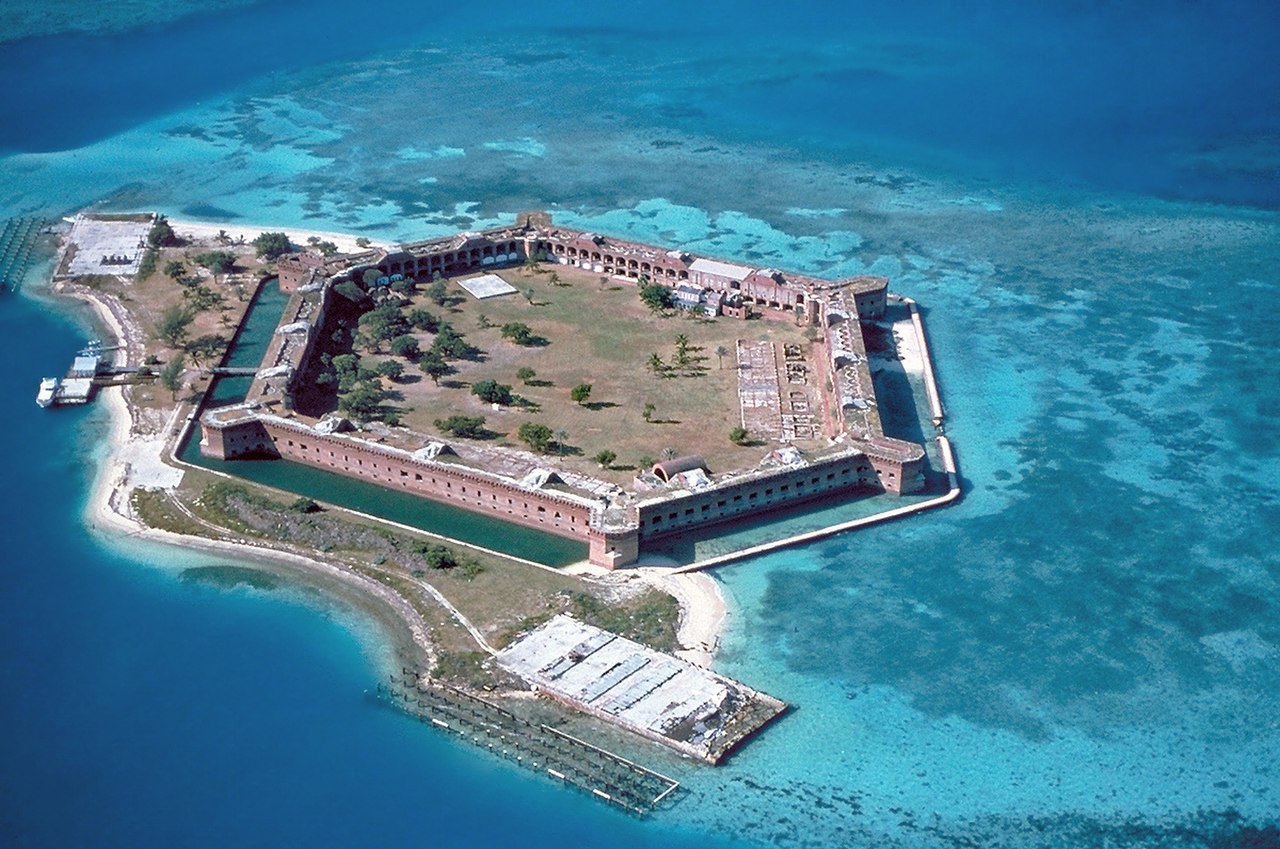
Dry Tortugas National Park is a United States national park that contains a cluster of islands about 70 mi west of Key West, Florida, on Garden Key.
1 sights · 1 places to stay
Updated from Wikivoyage on 1 October 2026 · Something wrong or missing? Improve it on Wikivoyage
Best things about Dry Tortugas National Park
Fort Jefferson
Fort Jefferson, the largest all-masonry fort in the United States, was built between 1846 and 1875 to protect the nation's gateway to the Gulf of Mexico. During the Civil War, it was used as a Federal prison primarily fo…
Plan your trip
Best time to visit & weather
Most comfortable: Nov–May. Summer highs reach about 91°F; winter lows dip to about 66°F. Very hot (Jul, Aug) — plan outdoor time for mornings. Wettest: Sep and Oct. (climate data from nearby Key West)
Blue bars: average daily high and low (°F). Purple columns: average monthly rain and melted snow (inches).
Getting there
- From you: to see whether to drive or fly, and how long it takes.
- EYW Key West International Airport, Key West — 70 mi away. Directions
- RSW Southwest Florida International Airport, Fort Myers — 149 mi away (major hub). Directions
The park is open year round during daylight hours, and is only accessible by boat or seaplane.
Full “Get in” guide ↓Budget & where to stay
No prices are listed for this place yet. See the Sleep guide ↓ for options.
Food for you
What to ask about, for your diet
Diet labels come from each listing's description and cuisine; “likely” means the cuisine usually has good choices, not a promise. Check with the restaurant. Open the food finder
Photos


Map
Every listing with a location. Tap a pin for its Google Maps link.
Understand
History
Construction of Fort Jefferson was begun in 1846 but never completed. President Franklin Roosevelt declared it and the waters surrounding it a National Monument in 1935.
Landscape
Flora and fauna
Climate
The Dry Tortugas exist in a subtropical climate. Temperatures range from the mid-50s to mid-80s (°F). April and May are often idyllic. There are essentially two seasons: The winter season (December-March), which can be windy with rough seas, and the tropical storm season (June-November) during which Dry Tortugas experiences both hot, humid weather and calm seas or severe weather events. Due to the ever-changing weather patterns, an accurate weather forecast is recommended before your visit.
Visitor information
Get in
The park is open year round during daylight hours, and is only accessible by boat or seaplane.
Fees and permits
The $10 (as of 2020) entrance fee for individuals is valid for seven days.
Get around
This is a cluster of 7 small islands not connected by causeway to the rest of the Florida Keys. As such the only way to reach them (and travel between them) is by boat or seaplane.
The largest of the islands, Garden Key, hosts Fort Jefferson. Walking tours are provided and snorkeling is a must. All traffic is on foot.
See
See Fort Jefferson
Fort Jefferson, the largest all-masonry fort in the United States, was built between 1846 and 1875 to protect the nation's gateway to the Gulf of Mexico. During the Civil War, it was used as a Federal prison primarily for Union deserters, though in 1865 three of the Lincoln conspirators were imprisoned within its walls.
Do
Popular activities include snorkeling, scuba diving, guided fishing trips, guided wildlife viewing trips, and sailing charters.
Buy
Shop Gift Shop
A small National Park Service Gift Shop is available inside Fort Jefferson on Garden Key. It offers a very limited selection of items.
Sleep
Lodging
Camping
There's a small campground on the island, with overflow space when the official campsites are full. You must bring all your own drinking water. Camping is not allowed outside the official campground.
Stay Garden Key Campground
8 sites, 1 group site. All sites are first-come, first-served. A primitive campground is located on Garden Key, the same island as Fort Jefferson, and is a short walk from the public dock. Individual sites can each accommodate up to 3 2-person tents (total of 6 people). Should a regular campsite not be available, an overflow area is provided. All campers, once they arrive will be guaranteed a place to camp.
Backcountry
Stay safe
The invasive lionfish has been spotted around Fort Jefferson. They can be identified by their red and cream colour and long spines. Stings are excruciatingly painful and can be fatal. Any sighting of the fish should be reported to National Park Staff immediately.
Nearby


My experience
Write about your trip here. Notes save automatically in this browser as you type; back them up from My journal.