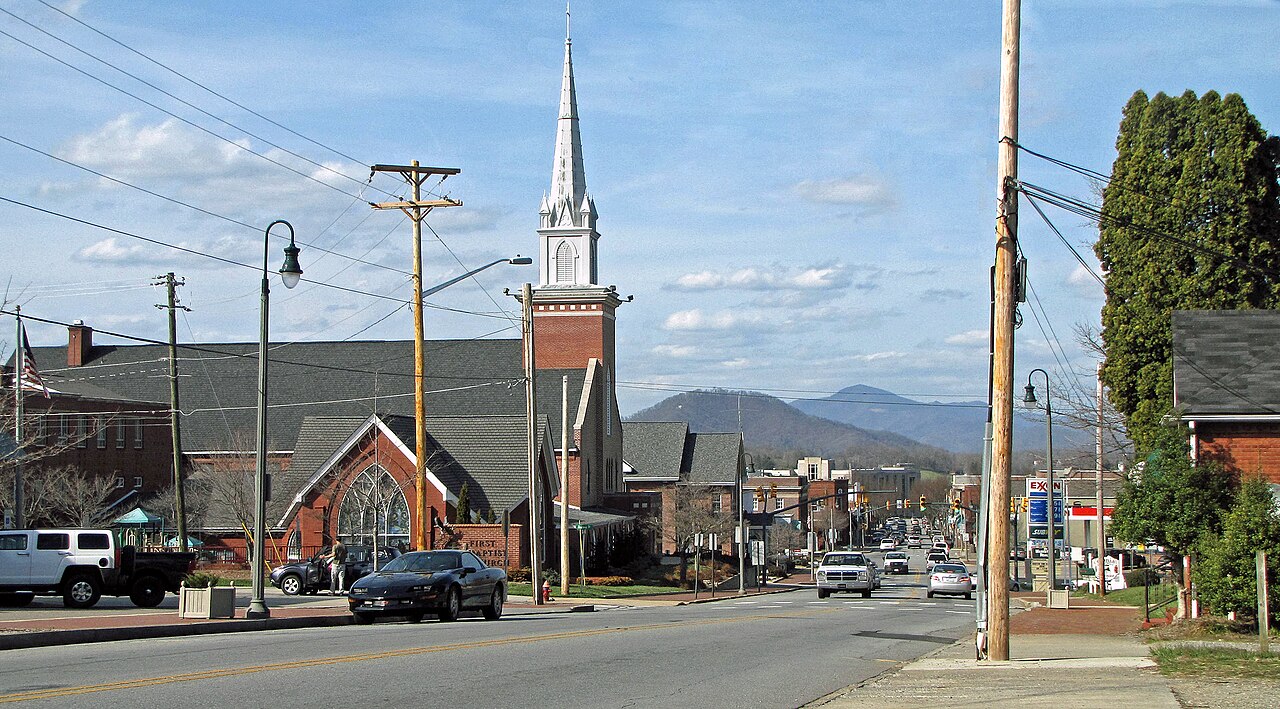
Overview
Waynesville is a city of 10,000 people (2019) in the Mountain Region of western North Carolina. It grew as an agricultural, lumber and railroad hub, and is home to many historical buildings.
14 sights
Updated from Wikivoyage on 1 October 2026 · Something wrong or missing? Improve it on Wikivoyage
Best things about Waynesville
Boone-Withers House
It was built about 1883, and is a 2½-story, Late Victorian style frame dwelling.
Citizens Bank and Trust Company Building
A two-story, brick and marble front rectangular building in the Classical Revival style
Francis Grist Mill
A functioning Grist Mill that was built in 1887. It is a 1½-story, heavy timber frame mill building sheathed in board-and-batten siding.
Frog Level Historic District
It includes Early Commercial architecture and Romanesque architecture. The buildings are predominantly one- and two-story brick or frame buildings dating from the first three decades of the 20th century. Notable building…
Haywood County Courthouse
It was built in 1932, and is a three-story, ashlar stone veneered rectangular building in the Classical Revival style.
Alden and Thomasene Howell House
It was built about 1905, and is a 2½-story, Shingle Style frame dwelling.
Plan your trip
Best time to visit & weather
Most comfortable: Apr–Oct. Summer highs reach about 85°F; winter lows dip to about 29°F. Wettest: Aug and Jun. (climate data from nearby Asheville)
Blue bars: average daily high and low (°F). Purple columns: average monthly rain and melted snow (inches).
Getting there
- From you: to see whether to drive or fly, and how long it takes.
- AVL Asheville Regional Airport, Asheville — 25 mi away. Directions
- GSP Greenville-Spartanburg International Airport, Greenville/Greer/Spartanburg — 59 mi away. Directions
- TYS McGhee Tyson Airport, Knoxville/Maryville — 61 mi away (major hub). Directions
Waynesville is connected to Interstate 40 and the rest of southwestern North Carolina via the Great Smoky Mountains Expressway, providing easy access from Knoxville and Asheville. The Great Smoky Mountains Expressway is a four-lane divided highway between Sylva and Exit 98 near West Waynesville. Then it is a four-lane freeway to Interstate 40 near Canton. It has exits for Hazelwood, West Waynesville and Russ Avenue through the town.
Full “Get in” guide ↓Budget & where to stay
No prices are listed for this place yet. See the Sleep guide ↓ for options.
Sample 3-day itinerary
Day 1
- Morning Boone-Withers House, Frog Level Historic District, Masonic Hall
- Afternoon Frank Smathers House, Dr. J. Howell Way House
Day 2
- Morning Citizens Bank and Trust Company Building, Haywood County Courthouse, Charles and Annie Quinlan House
- Afternoon Spread Out Historic District, Waynesville Main Street Historic District
Day 3
- Morning Francis Grist Mill, Alden and Thomasene Howell House
- Afternoon Clyde H. Ray Sr. House, Waynesville Municipal Building
Stops are grouped by area so each day needs little backtracking. Check opening hours before you go.
Food for you
What to ask about, for your diet
Diet labels come from each listing's description and cuisine; “likely” means the cuisine usually has good choices, not a promise. Check with the restaurant. Open the food finder
Photos


Understand
History
Waynesville was the scene of the last and perhaps most unusual skirmish in the eastern theater of the American Civil War. On May 6, 1865, Union Colonel William C. Bartlett's 2nd North Carolina (Federal) Mounted Infantry were attacked at White Sulphur Springs (east of Waynesville) by a detachment of rebels from Thomas' Legion of Highlanders, who had been summoned by locals.
Get in
Waynesville is connected to Interstate 40 and the rest of southwestern North Carolina via the Great Smoky Mountains Expressway, providing easy access from Knoxville and Asheville. The Great Smoky Mountains Expressway is a four-lane divided highway between Sylva and Exit 98 near West Waynesville. Then it is a four-lane freeway to Interstate 40 near Canton. It has exits for Hazelwood, West Waynesville and Russ Avenue through the town.
Asheville Regional Airport and Knoxville's McGhee Tyson Airport are the nearest airports. Asheville is about a 40-minute drive east, Knoxville is an hour and a half to the northwest.
See
Buildings and places listed on the National Register of Historic Places:
See Boone-Withers House
It was built about 1883, and is a 2½-story, Late Victorian style frame dwelling.
See Citizens Bank and Trust Company Building
A two-story, brick and marble front rectangular building in the Classical Revival style
See Francis Grist Mill
A functioning Grist Mill that was built in 1887. It is a 1½-story, heavy timber frame mill building sheathed in board-and-batten siding.
See Frog Level Historic District
It includes Early Commercial architecture and Romanesque architecture. The buildings are predominantly one- and two-story brick or frame buildings dating from the first three decades of the 20th century. Notable buildings include the C.G. Logan Auto Company (c. 1915), the Medford Furniture Company (1912), the T.N. Massie & Son building (c. 1900), and the North Carolina National Guard Armory (1936).
See Haywood County Courthouse
It was built in 1932, and is a three-story, ashlar stone veneered rectangular building in the Classical Revival style.
See Alden and Thomasene Howell House
It was built about 1905, and is a 2½-story, Shingle Style frame dwelling.
See Masonic Hall
It is a three-story, Classical Revival style steel frame and brick building. The Three Seven is now a meeting and venue space
See Charles and Annie Quinlan House
It was built in 1901–1902, and is a 2½-story, transitional Queen Anne/Colonial Revival style frame dwelling.
See Clyde H. Ray Sr. House
It was built in 1901–1902, and is a 2½-story, Colonial Revival style frame dwelling with Queen Anne style design elements.
See Frank Smathers House (The Evergreens)
It was built in 1926, and is a 1 1/2-story, "H"-shaped, eclectic frame dwelling with Gothic Revival and Colonial Revival style design elements.
See Spread Out Historic District
It includes 67 contributing buildings in a predominantly residential section of Waynesville developed between about 1895 and 1958. It includes notable examples of Queen Anne, Colonial Revival, and Bungalow/American Craftsman style architecture. Notable buildings include Waynesville Presbyterian Church (c. 1907) and two late-1920s apartment buildings.
See Waynesville Municipal Building (Former US Post Office Building)
The Waynesville Municipal Building is a historic post office building built in 1917. It is a two-story, brick rectangular building in the Classical Revival style with a one-story rear extension.
See Dr. J. Howell Way House
The home is a large 3½-story brick dwelling retaining a lot of the woodwork, large carved fireplaces, and grand staircase with Queen Anne and Colonial Revival style design elements.
See Waynesville Main Street Historic District
It includes 35 contributing buildings in the central business district of Waynesville. It includes notable examples of Classical Revival style architecture.
Nearby

Maggie Valley
City / town · 6 listings · 5 mi away

Sylva
City / town · 3 listings · 15 mi away

Cherokee
City / town · 12 listings · 19 mi away

Brevard
City / town · 10 listings · 22 mi away

Asheville
City / town · 195 listings · 25 mi away
Bryson City
City / town · 5 listings · 26 mi away
Cashiers
City / town · 1 listings · 27 mi away

Marshall
City / town · 16 listings · 28 mi away
My experience
Write about your trip here. Notes save automatically in this browser as you type; back them up from My journal.