
Overview
The Near South is the home of several of Chicago's main attractions: the splendid Museum Campus, with three world-class (and fun!) natural science museums on the lakefront; Soldier Field, home of the NFL's Chicago Bears; and McCormick Place, the city's massive convention center.
There's more to be found at the street level, though, which includes the fascinating and eerie Prairie Avenue, the eclectic Printer's Row, and the condo towers of the South Loop. Also, there are a couple of major jazz and blues landmarks in the area, which is bounded by Harrison St to the north, the Chicago River and Clark St/Federal St to the west, 26th St to the south, and Lake Michigan to the east.
14 sights · 6 things to do · 13 places to eat · 7 bars & cafés · 5 places to stay
Updated from Wikivoyage on 1 October 2026 · Something wrong or missing? Improve it on Wikivoyage
Best things about Near South

Adler Planetarium
It's the smallest of the three museums, but the oldest planetarium in the Western Hemisphere still packs a lot of fun. There are some interactive exhibits on the second floor, a scale model of the solar system, a few spa…

Field Museum of Natural History
The largest museum on the campus; highlights include SUE, the largest Tyrannosaurus Rex skeleton in the world, and the man-eating Tsavo lions. Part of the collection came directly from the 1893 World's Columbian Expositi…

John G. Shedd Aquarium
Home to a massive collection of marine life from throughout the world, among the very best you'll ever see. The Pacific Northwest-themed Oceanarium features otters, beluga whales, and a panoramic view of Lake Michigan, a…
The Clarke House Museum
Built in 1836, this unassuming little white house is the oldest surviving structure in Chicago. Tours are available through the Glessner House, but it's free to walk around the lovely Women's Park & Gardens that surr…
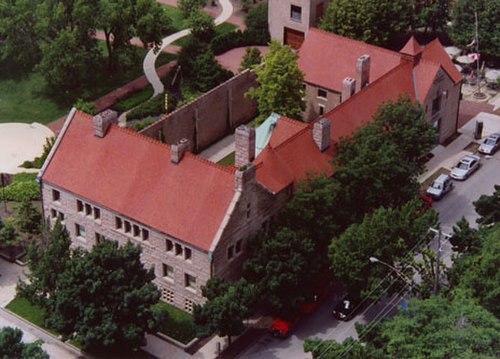
The Glessner House Museum
A stately Arts & Crafts mansion from 1887, now fully restored and refurnished to its original Gilded Age atmosphere. The staff are knowledgeable and enthusiastic.

William W. Kimball House
A stately Châteauesque mansion from 1892 across the street from the Glessner House, often cited as one of the country's most important examples of this architectural style. No tours are offered, as the property is home t…
Plan your trip
Best time to visit & weather
Most comfortable: May–Oct. Summer highs reach about 85°F; winter lows dip to about 20°F. Cold months (Jan, Feb, Dec) can bring snow and ice; check road conditions. Wettest: May and Jun. (climate data from nearby Chicago)
Blue bars: average daily high and low (°F). Purple columns: average monthly rain and melted snow (inches).
Getting there
- From you: to see whether to drive or fly, and how long it takes.
- MDW Chicago Midway International Airport, Chicago — 8 mi away (major hub). Directions
- ORD Chicago O'Hare International Airport, Chicago — 16 mi away (major hub). Directions
The CTA Red Line stops near Printer's Row (Harrison) and in the South Loop (Roosevelt/State, Cermak-Chinatown). Printer's Row is within reach of the Blue Line (LaSalle/Congress), too. The South Loop is also served by the Orange Line (Roosevelt/Wabash) and the Green Line (Roosevelt/Wabash, Cermak-McCormick Place).
Full “Get in” guide ↓Budget & where to stay
- Places to stay listed here: about $119–$180 a night (typical $153), from 5 listed prices.
- Typical meal: about $8 per person at listed restaurants.
- Estimated daily budget per person (room, two meals, local transport and an activity): budget ~$150, mid-range ~$200, comfortable ~$290.
See the Sleep guide ↓ for places to stay.
Sample 3-day itinerary
Day 1
- Morning The Clarke House Museum, National Veterans Art Museum, The Glessner House Museum
- Lunch Eleven City Diner
- Afternoon William W. Kimball House, Marshall Field Jr. Mansion
- Dinner Harold's Chicken Shack #62
- Evening Hackney's
Day 2
- Morning Adler Planetarium, FirstMerit Bank Pavilion at Northerly Island, Northerly Island Park
- Lunch Panozzo's Italian Market
- Afternoon Soldier Field, Field Museum of Natural History
- Dinner Pat's Pizza
- Evening Buddy Guy's Legends
Day 3
- Morning Dearborn Station
- Lunch Standing Room Only
- Afternoon River City
- Dinner Yolk
- Evening Kasey's Tavern
Stops are grouped by area so each day needs little backtracking. Check opening hours before you go.
Food for you
There are restaurants in each of the museums on the Museum Campus; the prices will replace the wonder of science with the wince of cold, hard economics. (It's odd enough that the Shedd Aquarium has a seafood restaurant, but no, you are not allowed to make selections from the aquarium floor.) If the weather's nice, take advantage of the beautiful scenery and bring a picnic lunch.
Cuisine (tap to filter)
What to ask about, for your diet
Diet labels come from each listing's description and cuisine; “likely” means the cuisine usually has good choices, not a promise. Check with the restaurant. Open the food finder
Photos


Map
Every listing with a location. Tap a pin for its Google Maps link.
Understand
The neighborhoods of the Near South are among the oldest settlements in Chicago. They were once the most prestigious — and notorious — in the entire city. After being forgotten for several decades, they have been re-discovered and are buzzing with new activity.
Prairie Avenue, in particular, was the prestige address of Gilded Age Chicago, when the city was building fortunes at a rate unlike any the world had ever seen. At the time of the World's Columbian Exposition in 1893, held a few miles to the south, 75 of the world's richest men lived on "Millionaire's Row," in mansions with gas-lit grand ballrooms, golden chandeliers, and no pretense of modesty. Eventually, the city's elite moved to the Gold Coast, and the area fell into rapid decline; soon, it was all but abandoned. Today, of the eleven surviving residences on Prairie Avenue, nine are protected as Chicago landmarks. This is the Gilded Age as if the millionaires simply got up and left, leaving their mansions to weather the elements for over a hundred years.
The Museum Campus was born shortly before the 1933 World's Fair, as Chicago's business community set about to recapture the energy of the landmark 1893 Exposition. The Field Museum had opened in the building that now houses the Museum of Science and Industry, and moved to this choice location by the lake in 1921, soon to be joined by the Adler Planetarium and the Shedd Aquarium, each of which boasts world-class collections within their respective fields. They are housed in beautiful, historic buildings along the lakefront, making a stroll through the area worth your time even if your budget won't let you through the front gates.
Printer's Row is a small and surprisingly tight-knit neighborhood just south of the Loop, centered around Harrison and Dearborn. In its early days, as an off-shoot of the infamous Levee District a few blocks south, it was the yin to Prairie Avenue's yang. In time, crusaders managed to force the closure of the bordellos and gambling houses, and Printer's Row earned its current, more respectable name, from its role as the center of Chicago's publishing industry. The area fell into disuse, but then fortunes changed again; those warehouses and publishing houses became perfect stock for conversion to trendy loft residences. It has a reputation as an eclectic home to artists and writers, who moved in to enjoy the cheap downtown real estate along Dearborn. To be sure, the outrageous boom in downtown Chicago property values is bringing in a more white-collar crowd of lawyers and traders, but the neighborhood retains some of its eclectic, book-loving feel. It's a pleasant evening alternative to the Near North if you are looking for a helping of Chicago blues or an interesting restaurant.
Similarly, the South Loop was once as busy as the rest of the Loop, and then, as development shifted northward, it became known as the place where the hustle and bustle of the Loop trailed off, a quiet zone between Bronzeville and the central business district. Today, however, it's something else entirely — a mad rush of new construction has overtaken the place, with historic stone edifices interspersed among new steel-and-glass towers in varying stages of readiness, and trendy restaurants to exercise the wallets of the people who live there.
Get in
By train
The CTA Red Line stops near Printer's Row (Harrison) and in the South Loop (Roosevelt/State, Cermak-Chinatown). Printer's Row is within reach of the Blue Line (LaSalle/Congress), too. The South Loop is also served by the Orange Line (Roosevelt/Wabash) and the Green Line (Roosevelt/Wabash, Cermak-McCormick Place).
Both stations on Roosevelt are within walking distance of the Museum Campus, although buses and free trolleys also run the route.
By bus
The CTA runs a few convenient buses through the area:
- 4 Cottage Grove is a convenient north/south route along Michigan Ave, which leads to and from the South Side along Dr Martin Luther King Jr Dr, and Cottage Grove Ave.
- 6 Jeffrey Express comes from the South Side along Lake Shore Dr and stops at Roosevelt and Congress, which is close enough to reach the major attractions.
- 12 Roosevelt meets the CTA train stations and runs down Roosevelt to the edge of the Campus.
- 130 Grant Park runs directly from Union Station in the Loop during the summer.
- 146 Michigan is a tourist favorite, running southbound from Michigan Avenue in the Near North, though the Loop and past Grant Park, and arrives at Soldier Field and the Museum Campus.
By car
Don't drive to the Near South without a good reason; parking is scarce and often expensive, especially around Soldier Field, the Museum Campus, and McCormick Center.
If you choose to drive, Lake Shore Drive is the key artery from the north or south, passing Soldier Field, McCormick Place, and the Museum Campus. Exits are clearly marked with lists of attractions. For the Museum Campus and Soldier Field, exit at 18th Street/McFetridge Drive. Coming from the Loop to the north and Bronzeville to the south, Michigan Avenue runs through the commercial and residential center of the area. Coming along the Stevenson Expressway, there are exits on to State Street, King Drive, and Lake Shore Drive.
In Printer's Row and the South Loop, parking is more or less what you would expect in the Loop — look for a multi-story garage and expect to pay over $10 for a couple of hours. For the museums and McCormick Place, parking is available at public lots for $15 on days without special events, and totally unavailable on Sunday home games for the Bears; in that case, you'd be much better advised to come back another day.
By boat
For those coming to the Near South from the Loop, specifically Navy Pier, the water taxi operated by Shoreline Sightseeing is an attractive option. Good views, rarely crowded and a lake breeze; plus it drops off right at Museum Campus. Only runs during warmer weather months (April-October), but departures are frequent while it is in service (every 20 or so minutes). Monday-Thursday: $8, $4 children. Friday-Sunday and holidays: $10, $5 children. Also connects to a few stops on the Chicago River.
See
Museum Campus
All three museums are within a short, pleasant walk from each other, even with toddlers and strollers in tow, so it's worth setting aside an entire day for your visit. Try to get your tickets in advance, though, as lines can be hellacious. All three museums sell tickets on-line, eliminating the wait. The two major discount packages, CityPass and Go Chicago Card, may come in handy if you're planning to visit all three, but they do not necessarily cover admission to special exhibits. If you're staying with family and you can pass for Aunt Millie or Uncle Chuck, borrow their ID; Chicago residents receive a discount with proof of residency (usually $2 or so). Mondays and Tuesday are sometimes discounted, depending on the season.
See Adler Planetarium
It's the smallest of the three museums, but the oldest planetarium in the Western Hemisphere still packs a lot of fun. There are some interactive exhibits on the second floor, a scale model of the solar system, a few space rocks, and two high-tech dome theaters with nifty "star shows" throughout the day. Adler After Dark, on the third Thursday of each month, runs 6PM-10PM and features cocktails, a DJ, and wild, unfettered use of telescopes.
See Field Museum of Natural History
The largest museum on the campus; highlights include SUE, the largest Tyrannosaurus Rex skeleton in the world, and the man-eating Tsavo lions. Part of the collection came directly from the 1893 World's Columbian Exposition, adding a layer of intrigue to all of those dusty old animals. Another highlight is the great, kid-friendly Egyptian exhibit, and the Hall of Gems will impress, too. Traveling exhibitions tend to be excellent, so this is one place where it's worth shelling out for the extra shows.
See John G. Shedd Aquarium
Home to a massive collection of marine life from throughout the world, among the very best you'll ever see. The Pacific Northwest-themed Oceanarium features otters, beluga whales, and a panoramic view of Lake Michigan, although you'll need to arrive extremely early for the (free) dolphin show. The terrific new Wild Reef exhibit offers floor-to-ceiling windows for an extraordinary view of a Philippine coral reef environment, complete with dozens of sharks.
Prairie Avenue
The Prairie Avenue Historic District includes the 1800 and 1900 blocks of South Prairie, the 1800 block of South Indiana and 211 through 217 East Cullerton. Neighborhood tours are led by the Glessner House Museum a few times each year. If you happen to be in the area on Halloween, move heaven and earth to join the evening ghost tour, which roams through the Glessner House, meeting a magician a few times along the way, and then heads out to the wonderfully spooky street for a walking tour.
See William W. Kimball House (U.S. Soccer House)
A stately Châteauesque mansion from 1892 across the street from the Glessner House, often cited as one of the country's most important examples of this architectural style. No tours are offered, as the property is home to the United States Soccer Federation.
See Marshall Field Jr. Mansion
No tours are offered, as this long-derelict property has been rehabbed and divided into condos. This was the site of one of the great scandals of the Gilded Age. It was built by Marshall Field, the richest and most powerful man in Chicago, for his son. In 1905, the younger Field was found dead in his home under mysterious circumstances from a bullet wound. After two days, the family made the announcement that the bullet had been fired by accident during preparation for a hunting trip. According to rumors, though, he had been shot in a brothel in the notorious Levee. The elder Field died the next year, and the end of the Prairie Avenue era had begun.
See Willie Dixon's Blues Heaven Foundation (Chess Records Studio)
A major blues hotspot where Muddy Waters, Ahmad Jamal, Chuck Berry, Aretha Franklin, Bo Diddley, Etta James, Buddy Guy, John Lee Hooker, Ramsey Lewis, and many other greats recorded during Chicago's bluesiest period. The Rolling Stones also recorded here, paying tribute in their instrumental "2120 S Michigan Avenue." Public tours.
Printer's Row
As the Loop trails off into Printer's Row, there are still a few impressive buildings to be seen, especially on Dearborn and Plymouth. The Pontiac Building at 542 S Dearborn is one of Chicago's oldest skyscrapers (Holabird & Roche, 1891), and the buildings at 731 S Plymouth and 718 S Dearborn have intriguing details that call back to their publishing past.
Today, the major draws of Printer's Row are the bookstores — see below.
See Dearborn Station
Built in 1885, this was one of the great stations of the railroad era, the first glimpse of Chicago for countless visitors from across the country. (It also became a focal point for the anti-vice crusaders, with pamphlets describing lurid tales in which innocent farm girls fresh off the train were seized and sold into prostitution.) The rail yard is gone, with traffic having ceased in 1971, but the station house has been renovated into mixed-use commercial space, with a bar and restaurant on the ground floor.
Others
See Hilliard Homes
In the architecture of these massive public housing projects lies the South Side's tongue-in-cheek answer to the North Side's Marina City — in fact, they were built by the same architect, Bertrand Goldberg. With its enormous corncob towers and northern semicircular wall, the Hilliard Homes are impossible to miss when traveling between Downtown and Chinatown. Despite the architectural distinction of being the only public housing projects to get on the National Register of Historic Places, the towers have not always been a great place to live, suffering from urban blight similar to that found in public housing throughout the country. A mixed-income residential development was completed in 2006.
See River City
Another Bertrand Goldberg corncob project, whose riverside location offers great views and frequently flooded basements. They're condominiums, so pretend to be interested in buying one if you'd like a free tour.
Do
Do FirstMerit Bank Pavilion at Northerly Island
This small peninsula, jutting out into Lake Michigan, was the site of Meigs Airport until Mayor Daley's midnight demolition in 2003; now it's a 7500-seat concert venue for touring rock and hip-hop acts. A new nature park has been built south of the Pavilion.

Do McCormick Place
Mayor Richard J. Daley believed firmly — as his son, Mayor Richard M., did after him, and all subsequent mayors have — in total, ruthless domination of the convention circuit. Hence, the massive complex of McCormick Place, which is struggling to stay ahead of rivals in Las Vegas and Orlando. There's little reason to seek out McCormick Place unless your business is sending you there or you want to catch an event at Wintrust Arena (immediately below). That said, the auto shows are a draw for some visitors.
Do Wintrust Arena
An arena seating a little more than 10,000 that opened in fall 2017 as the main event venue for McCormick Place. Its highest-profile tenants are the DePaul Blue Demons men's basketball team (college) and the Chicago Sky of the WNBA. The DePaul women's basketball team splits its home games between here and its smaller on-campus arena.

Do Soldier Field
Home of the NFL's Chicago Bears, and from 2020 home (again) to Chicago Fire FC of Major League Soccer. If you'd like to see a Bears game, then you have something in common with many Chicagoans; there's no point in listing ticket prices, because they sell out long before the season starts. On the other hand, if you're a soccer fan, you have a much better chance of getting in for a Fire game, even though that team plans on using only the lower seating bowl for most of its games. The original Soldier Field was built in 1924 to honor veterans of the First World War, and was added to the National Register of Historic Places in 1984. By 2002, the stadium was in dire need of renovations, and the Bears promised to preserve the majestic colonnades of the old stadium. However, when the renovations were complete, what appeared to be a giant spaceship had landed at midfield. The amenities have improved, and it really is a nice facility... on the inside. On the outside, it's hard to say what it is, other than probably the strangest-looking sports venue in America. (It's not a Historic Place any more, having been stripped of that designation in 2006.) Tours are available during the week, M-F 9AM-5PM, by phone appointment; $15 adults, $10 students, $7 seniors, $4 children.
Buy
The Near South is not a shopping destination; there is no need really, given that some of the world's most intense shopping experiences may be had in the two miles to the north. But a trip to Printer's Row can be a refreshing change of pace for downtown visitors who would prefer to browse independent bookstores.
Eat
There are restaurants in each of the museums on the Museum Campus; the prices will replace the wonder of science with the wince of cold, hard economics. (It's odd enough that the Shedd Aquarium has a seafood restaurant, but no, you are not allowed to make selections from the aquarium floor.) If the weather's nice, take advantage of the beautiful scenery and bring a picnic lunch.
Budget
Eat Eleven City Diner
New York-style Jewish diner.
Eat Harold's Chicken Shack #62
The prices are higher and the quality lower at this central location of the great South Side chain, but it's still a great cheap eat.
Eat Panozzo's Italian Market
A neighborhood deli with sandwiches and such. Perfect place to prepare a picnic lunch for a day at the Museum Campus.
Eat Pat's Pizza
Cheap thin-crust pizza with a devoted following. Lunch during the work-week is crowded.
Eat Standing Room Only
Burgers of the standard, turkey, and veggie variety. As the name says, it's standing room only.
Eat Yolk
Breakfast place with egg-based dishes (obviously) and bright yellow walls (you've been warned).
Mid-range
Eat Bongo Room
Great breakfast/brunch location with no signage, a spin-off of the original Wicker Park restaurant.
Eat Kroll's Chicago
Sister branch of a Green Bay fixture, which is a controversial move in the heart of Bears territory. They offer a big menu of seafood and sandwiches from a charcoal grill. Plenty of beer is available, but kids are welcome.
Eat La Cantina Grill
Unpretentious, good Mexican cuisine. Live music on Friday nights.
Eat South Coast
BYOB sushi bar.
Splurge
Eat Chicago Firehouse Restaurant
Fine American dining.
Eat Gioco
Offers "rustic Italian" dishes.
Drink
Blues and jazz fans staying downtown have a real reason to come to the Near South at night in the form of two legendary clubs: Buddy Guy's Legends for the blues and the Velvet Lounge for jazz.
Drink Buddy Guy's Legends
A famous, fairly large blues club with a Cajun/soul food menu and frequent big-name acts. Buddy Guy himself holds court every January.
Drink Kasey's Tavern
Excellent dive bar in historic Printer's Row. Extensive beer selection, disgusting bathrooms and "Absolutely No Dancing." Kasey's is good for a drink before or after a Sox game.
Drink Kitty O'Shea's
Better than your average hotel bar, with a stately ambiance that's nevertheless hospitable to Bears fans on their way back from Soldier Field or Grant Park festival-goers.
Do Jazz Showcase
Started in 1948 by Joe Segal, this historic jazz club is home to both national touring acts and the finest local jazz musicians Chicago has to offer. It is in the historic Dearborn Station building in the South Loop. Segal maintains the high standard for acoustic jazz that over the years has featured luminaries from Dizzy Gillespie to Chick Corea.
Drink M Lounge
Martinis and jazz; live performances Tu W 7PM-10PM. Nights with music supposedly have a two drink minimum, but for cheapskates, it is unclear how this policy would be enforced.
Drink Reggie's
Reggie's Music Joint is a nice bar and grill that offers nightly live music, mostly by local rock bands, as well as a professional blues jam session every Wednesday night. Reggie's Rock Club features bigger-name touring rock acts. If you want to take some music home, head upstairs over the Rock Club to Record Breakers, which sells new and used CDs, LPs, and other rock paraphernalia.
Drink The Velvet Lounge
Another essential stop on The Jazz Track, best reached by taxi. If you want to go to a bar that represents the real Chicago jazz tradition from Louis Armstrong right up to Pharaoh Sanders, then you must go to the Velvet Lounge.
Sleep
Since there are so many hotels in the Loop and the Near North, there has never been much demand for them here. Any Loop hotels that are close to Grant Park will also be within pretty reasonable distance of the Museum Campus and McCormick Place.
Go next
- If you came here looking for blues and jazz, you may want to head further to the South Side home of the blues in Chatham-South Shore.
- And if you had fun at the Museum Campus, even more awaits you at the Museum of Science and Industry in Hyde Park.
- Hurting for good Chinese food? Find great Chinese food in nearby Chinatown. Take bus #18 from Prairie Avenue or #21 from McCormick Place.
Nearby

Cicero
City / town · 5 listings · 7 mi away

Berwyn
City / town · 2 listings · 9 mi away

Oak Park
City / town · 19 listings · 9 mi away

Evergreen Park
City / town · 10 listings · 10 mi away

Brookfield
City / town · 3 listings · 12 mi away

Oak Lawn
City / town · 12 mi away

Burbank
City / town · 12 mi away

Melrose Park
City / town · 13 mi away
My experience
Write about your trip here. Notes save automatically in this browser as you type; back them up from My journal.